Saturday, August 30, 2025
DH25011 Oesophageal Cancer Diagnosis Company V01 300825

Saturday, August 23, 2025
DH25010 Biological CAD V01 230825
These platforms aim to make biology designable—like how CAD is used in engineering—to accelerate drug discovery, synthetic biology, and therapeutic development.
🔬 What is a Biotech CAD Platform?
A biotech CAD platform is software (often cloud-based, with AI/ML integration) that allows researchers to:
• Design genetic constructs (e.g., promoters, circuits, CRISPR edits)
• Simulate cellular behavior before wet-lab testing
• Optimize DNA sequences for expression and stability
• Automate lab workflows (integration with robotics and cloud labs)
They essentially bring engineering principles—modularity, abstraction, standardization—to biological R&D.
⚙️ Key Players in Biotech CAD Platforms
1. Asimov, Inc. (Asimov.com)
• Focus: Synthetic biology for therapeutics, especially genetic circuits and biologics.
• Key Offering: Large library of validated genetic parts, host cells, and AI-powered design tools.
• Unique Edge: Ties to MIT’s Voigt Lab and DARPA projects; specializes in predictive models of biology.
• Use Cases: Next-gen cell therapies, antibody optimization, gene therapy vectors.
2. Ginkgo Bioworks
• Focus: A “foundry” for designing custom organisms.
• Platform: Uses automation + software (Codex) to design DNA and test thousands of genetic variants.
• Unique Edge: Operates one of the world’s largest automated organism foundries.
• Use Cases: Industrial enzymes, agriculture, fragrance molecules, COVID-19 biosurveillance.
3. TeselaGen
• Focus: Cloud-based platform for DNA design, molecular biology workflows, and strain optimization.
• Platform: Modular “apps” (Design, Build, Test, Learn cycles).
• Unique Edge: Strong focus on collaboration + automation, integrates with lab robotics.
• Use Cases: Vaccine design, industrial strain engineering, biologics.
4. Benchling
• Focus: R&D data management platform for biotech, used by 200k+ scientists.
• Platform: Cloud-based suite for DNA design, protein design, lab notebooks, and collaboration.
• Unique Edge: Dominates lab informatics; widely adopted in pharma/biotech.
• Use Cases: End-to-end R&D project management, CRISPR edits, antibody design.
5. Genomatica
• Focus: Metabolic pathway and strain design for sustainable chemicals.
• Platform: Combines computational modeling + CAD tools to design industrial microbes.
• Unique Edge: Focused on sustainable bio-manufacturing (e.g., nylon, detergents, cosmetics).
• Use Cases: Bio-based chemicals, greener supply chains.
6. Synple & Other Emerging Startups
• Synple: Focus on automating DNA/protein design workflows for smaller labs.
• DNA Script + Molecular Assemblies: Not CAD alone, but integrate digital biology design → DNA synthesis workflows.
• Arzeda: Uses AI to design novel proteins and enzymes.
🧩 Trends in Biotech CAD
1. Integration with AI/ML → Predict cellular behavior from DNA sequences.
2. Cloud labs + automation → “Design in silico, build automatically” (Design-Build-Test-Learn cycle).
3. Standardized parts & libraries → Making biology modular (like software libraries).
4. Therapeutics-first focus → Many companies (Asimov, Ginkgo, Benchling) are leaning into pharma, cell therapy, and biologics.
5. Open-source initiatives → Tools like CelloCAD (MIT) and SBOL (Synthetic Biology Open Language) standards for DNA parts sharing.
📊 Market Landscape
Company Specialty Unique Edge
Asimov Genetic circuits for therapy Predictive AI models, host cells
Ginkgo Organism foundry Scale & automation, wide applications
TeselaGen Modular CAD + automation DBTL (Design-Build-Test-Learn cycles)
Benchling Lab data management + DNA tools Pharma adoption, collaboration focus
Genomatica Industrial strain engineering Sustainability & green chemicals
✅ Bottom line: Biotech CAD platforms are becoming the “AutoCAD of biology”, where Asimov is carving out a niche in therapeutic genetic circuits, Ginkgo in organism design at scale, and Benchling in digital R&D management.
Would you like me to map out which CAD platform is best depending on use case (e.g., therapeutic biotech, academic labs, industrial biomanufacturing)?
Thursday, August 14, 2025
DH25009 Brain Chip V01 150825
Brain chip that translates thoughts into speech
Technology with the ability to decode a person’s inner thoughts and translate them into speech in real time has moved a step closer after the testing of a new brain implant, scientists have claimed.
Researchers at Stanford University in California said that their device was able, with 74 per cent accuracy, to detect a person’s “inner speech” — where they imagined saying a specified set of words in their mind without any effort to physically utter them — and decipher which words they were thinking about.
They said that it could represent a breakthrough for people with various forms of paralysis or impairments that prevent them from speaking unaided and could one day “restore communication that is as fluent, natural and comfortable as conversational speech”.
The researchers said that it could be a more effective system than existing forms of brain implant, which ask patients to attempt to form sounds and then analyse the movement of their vocal and facial muscles to decode what they are trying to say.
It would also be much faster than older technologies, such as those that track a user’s eye movements to select letters and type out words, they said.
“If you just have to think about speech instead of actually trying to speak, it’s potentially easier and faster for people,” Benyamin Meschede- Krasa, a PhD student and an author of the study, published in the journal Cell, said.
The study involved four people with severe paralysis from either amyotrophic lateral sclerosis (ALS) or a brainstem stroke and asked them to either attempt to speak or to imagine speaking a set of words.
They implanted tiny electrodes in the motor cortex of their brains, which controls speaking. They found that similar brain areas were activated when both imagining speech and actually attempting to speak, though the imagined speech produced weaker signals.
In a small proof-of-concept study, the device was able to identify pre-specified sentences created from a 125,000-word vocabulary with an accuracy rate of up to 74 per cent, powered by an artificial intelligence model.
The implant, part of a brain-computer interface (BCI), was also able to detect some words that the participants had not been instructed to say, including numbers when the participants were counting shapes on a screen.
This could prompt fears of systems being able to read a person’s thoughts against their wishes, so researchers also tested whether the users could activate the system by imagining a password and found that it worked with 98 per cent accuracy.
It is still not able to translate freeflowing speech without making significant errors, but researchers hope that improvements in the devices and the AI system will one day make that possible.
“The future of brain-computer interfaces is bright,” said Frank Willett, the study’s senior author. “This work gives real hope that speech BCIs can one day restore communication that is as fluent, natural, and comfortable as conversational speech.”
DH25008 AI creating new Antibiotics. V01 150825
Scientists use AI to create new superbug-killing antibiotics
Scientists have used artificial intelligence to design two antibiotics that could provide a powerful weapon against superbugs including MRSA.
In what scientists hope could start a “second golden age” in antibiotic discovery, the drugs, created by a team at the Massachusetts Institute of Techno- logy, were able to kill antibiotic-resistant gonorrhoea and MRSA in the laboratory and in tests on infected mice.
The MIT scientists used AI to design more than 36 possible compounds, which were each then screened by AI for antimicrobial properties.
The antibiotics with the most potential were created into chemical compounds, then tested on bacteria and on mice infected with an antibioticresistant strain of gonorrhoea and MRSA (methicillin-resistant Staphylococcus aureus). They showed “strong antibacterial activity” and were able to clear an MRSA skin infection in mice.
Before the drugs could be prescribed for humans, they need to be refined in the lab and then put through several rounds of clinical trials, a process that will take several years, according to the study published in the journal Cell.
Professor James Collins, the senior author, said: “We’re excited about the new possibilities that this project opens up for antibiotics development. Our work shows the power of AI from a drug design standpoint, and enables us to exploit much larger chemical spaces that were previously inaccessible.”
Most antibiotics in use today were discovered in the mid-20th century and scientists hope AI could provide a solution to the growing threat of antibiotic resistance. More than a million people a year die due to antimicrobial resistance.
This includes infections with the MRSA bacteria, sometimes called a “superbug” because it is resistant to several common antibiotics
DH25007 AI Heart Flow Analysis V01 140825
|


Wednesday, August 13, 2025
DH25006 Digital Brain Interfaces V01 140825
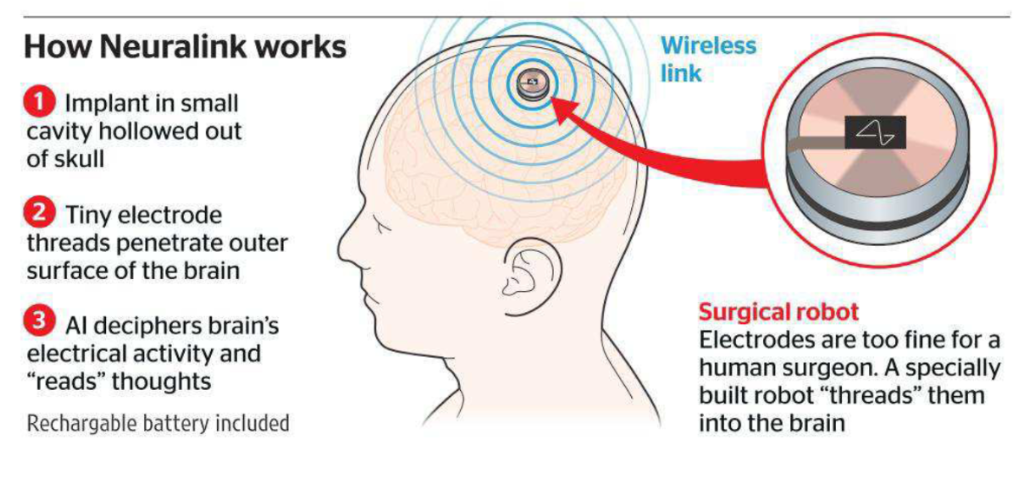
The rivalry between the two leading technology billionaires is moving into a new arena — the race to link human minds directly with machines.
Sam Altman, chief executive of OpenAI, the company behind ChatGPT, was once an ally of Elon Musk, the Tesla and SpaceX boss. The former partners are preparing to face off in the fast-developing field of brain– computer interfaces (BCIs).
These systems typically use artificial intelligence to translate brain activity into commands a computer can follow.
They have enabled people with paralysis to control devices using thoughts.
Advocates believe BCIs will one day allow humans to merge with AI.
Musk’s company, Neuralink, began testing its technology on patients in the United States last year and recently gained approval for a trial in Britain, its first in Europe.
Altman is backing Merge Labs, which aims to harness recent advances in AI to make BCIs faster and more capable, the Financial Times reported.
In 2015 the pair launched OpenAI together when Musk provided much of the capital to launch the venture. Musk quit the board three years later after disputes over its operation.
They have gone on to build competing AI empires while trading barbs.
Musk tried to block OpenAI’s transformation from a non-profit entity to a profit-seeking business.
BCIs are drawing interest from governments as well as tech moguls. In the UK, the Advanced Research and Invention Agency (Aria), a government body, is exploring their potential as part of a mission to fund science that could change the world. In China, a ministry has unveiled a device to restore hand movement in disabled patients.
Neuralink is widely seen as leading the field. Its coin-sized implant is designed to sit in the skull, with electrode “threads” extending into the brain to monitor the electrical activity of cells.
An AI system then decodes those signals into information that can be used to control external devices.
Last year it implanted a device in its first human volunteer, Noland Arbaugh, who was paralysed from the shoulders down in a diving accident.
Using the implant, he was able to move a computer cursor and play video games, an experience he likened to “using the force” in a nod to Star Wars.
Musk said he wanted to go further, including restoring sight to the blind and enabling quadriplegics to regain “full-body functionality”. His ultimate ambition is a mass-market device linking human minds to computers.
One industry figure who has discussed the matter with Musk said he saw this as necessary to stop AI running out of control.
Altman seems to share a similar longterm vision. He wrote last year in a blog that “high-bandwidth, brain-computer interfaces” were on the horizon.
The Financial Times said Merge Labs was seeking funding at a valuation of about $850 million. Altman is expected to help launch the project alongside Alex Blania, a German theoretical physicist and entrepreneur.
Sunday, August 3, 2025
DH25005 Royal Society of Biology (RSB) V01 030725
The leading UK biology scientific body is generally considered to be the Royal Society of Biology (RSB).
🔬 Royal Society of Biology (RSB)
• Role: It is the UK’s professional body for biologists and serves as the main voice for the life sciences.
• Functions:
• Represents and supports scientists, educators, and students in biology and related fields.
• Provides professional accreditation (e.g., Chartered Biologist status).
• Influences science policy and advises the UK government.
• Promotes education and public engagement in biology.
• Website: rsb.org.uk
Other Key Biology-related Bodies in the UK:
1. The Company of Biologists – Publishes major biology journals (Development, Journal of Cell Science, Journal of Experimental Biology).
2. Royal Society (RS) – Broader than biology (covers all sciences) but runs Open Biology and supports life science research.
3. Biochemical Society – Focused on biochemistry and molecular biology.
4. Microbiology Society – Specialised in microbiology.
If you’re asking specifically about the equivalent of the Institute of Physics (IOP) for biology, then the Royal Society of Biology (RSB) is the closest match.
Would you like me to compare RSB’s open access approach to IOP Publishing’s model?