The rivalry between the two leading technology billionaires is moving into a new arena — the race to link human minds directly with machines.
Sam Altman, chief executive of OpenAI, the company behind ChatGPT, was once an ally of Elon Musk, the Tesla and SpaceX boss. The former partners are preparing to face off in the fast-developing field of brain– computer interfaces (BCIs).
These systems typically use artificial intelligence to translate brain activity into commands a computer can follow.
They have enabled people with paralysis to control devices using thoughts.
Advocates believe BCIs will one day allow humans to merge with AI.
Musk’s company, Neuralink, began testing its technology on patients in the United States last year and recently gained approval for a trial in Britain, its first in Europe.
Altman is backing Merge Labs, which aims to harness recent advances in AI to make BCIs faster and more capable, the Financial Times reported.
In 2015 the pair launched OpenAI together when Musk provided much of the capital to launch the venture. Musk quit the board three years later after disputes over its operation.
They have gone on to build competing AI empires while trading barbs.
Musk tried to block OpenAI’s transformation from a non-profit entity to a profit-seeking business.
BCIs are drawing interest from governments as well as tech moguls. In the UK, the Advanced Research and Invention Agency (Aria), a government body, is exploring their potential as part of a mission to fund science that could change the world. In China, a ministry has unveiled a device to restore hand movement in disabled patients.
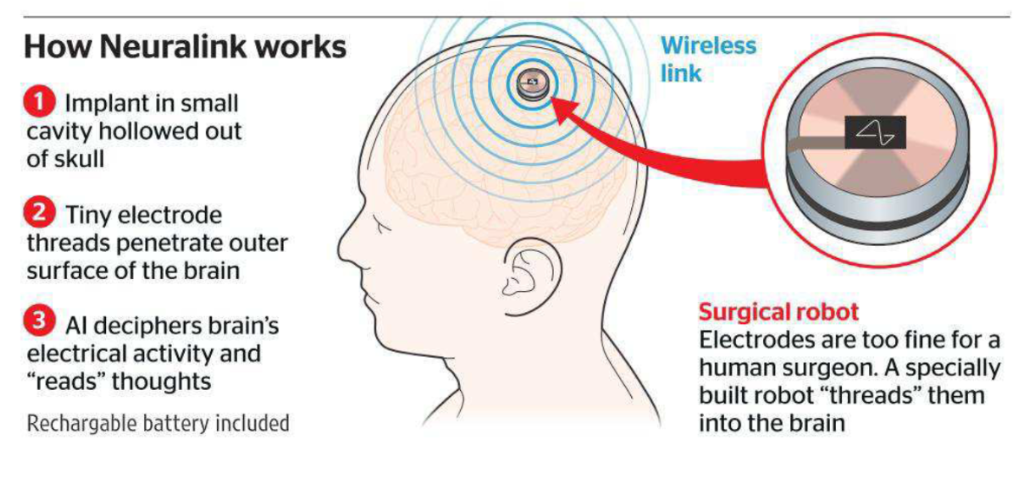
Neuralink is widely seen as leading the field. Its coin-sized implant is designed to sit in the skull, with electrode “threads” extending into the brain to monitor the electrical activity of cells.
An AI system then decodes those signals into information that can be used to control external devices.
Last year it implanted a device in its first human volunteer, Noland Arbaugh, who was paralysed from the shoulders down in a diving accident.
Using the implant, he was able to move a computer cursor and play video games, an experience he likened to “using the force” in a nod to Star Wars.
Musk said he wanted to go further, including restoring sight to the blind and enabling quadriplegics to regain “full-body functionality”. His ultimate ambition is a mass-market device linking human minds to computers.
One industry figure who has discussed the matter with Musk said he saw this as necessary to stop AI running out of control.
Altman seems to share a similar longterm vision. He wrote last year in a blog that “high-bandwidth, brain-computer interfaces” were on the horizon.
The Financial Times said Merge Labs was seeking funding at a valuation of about $850 million. Altman is expected to help launch the project alongside Alex Blania, a German theoretical physicist and entrepreneur.

No comments:
Post a Comment