Copyright The Times (080925)
When Ed Bullmore got Covid his physical and mental symptoms merged seamlessly: first, the fever and cough, then days feeling “gloomy, groggy and grumpy”. Most of us are familiar with the post-infection blues even though, as he says, “it wasn’t allowed by the 400-year-old Cartesian philosophy of western medicine for mental symptoms to have a physical cause”.
But Bullmore, one of the most prestigious research psychiatrists in the UK, is going further. Something similar — albeit more complicated — is at play with one of our most feared illnesses. It may be the piece of the puzzle that finally changes the way we understand medicine. It is also the only way to explain the new research into the role infections in pregnancy or babyhood play in your child getting schizophrenia two decades later.
“We’re not saying that schizophrenia is all in the mind,” Bullmore tells me.
“It’s not even all in the brain. It is the product probably of an interaction between the immune system and the brain over the course of development.”
Bullmore only knew one fact about his grandmother — she was locked up in an asylum. That’s all his father was prepared to say, such was the shame and stigma. When Bullmore decided to specialise in psychiatry after a promising start as a young medic, his parents received the news in funereal silence. They were, he tells me, “deeply disappointed”. Psychiatrists were deemed second class to proper doctors — hopeless weirdos, a bit like their patients. His medical tutor called his decision a “colossal waste of talent”.
Bullmore was sent to work in what was referred to as the “bins” on the outskirts of town, miles from colleagues in neuroscience, inflammatory and genetics specialisms. Going from physical to mental medicine was, he says, like crossing the demilitarised zone between South and North Korea: “Two completely separate things, one of which was sacred, the other shameful.”
We should be piling resources into mother and child health. I don’t understand why we’re not
He adds: “Mainstream medical culture still doesn’t embrace psychiatry as an equal partner.”
Bullmore has had an illustrious career as a professor at Cambridge and has just taken the helm at the school of psychiatry at King’s College London.
He talks with a wry punchiness that makes him comes across as a medic version of Bill Nighy. But at 64 the mission of his life is not yet done and he feels like he is running out of time.
It is nothing short of reuniting mental and physical medicine in a revolution that may prevent some of our most debilitating illnesses.
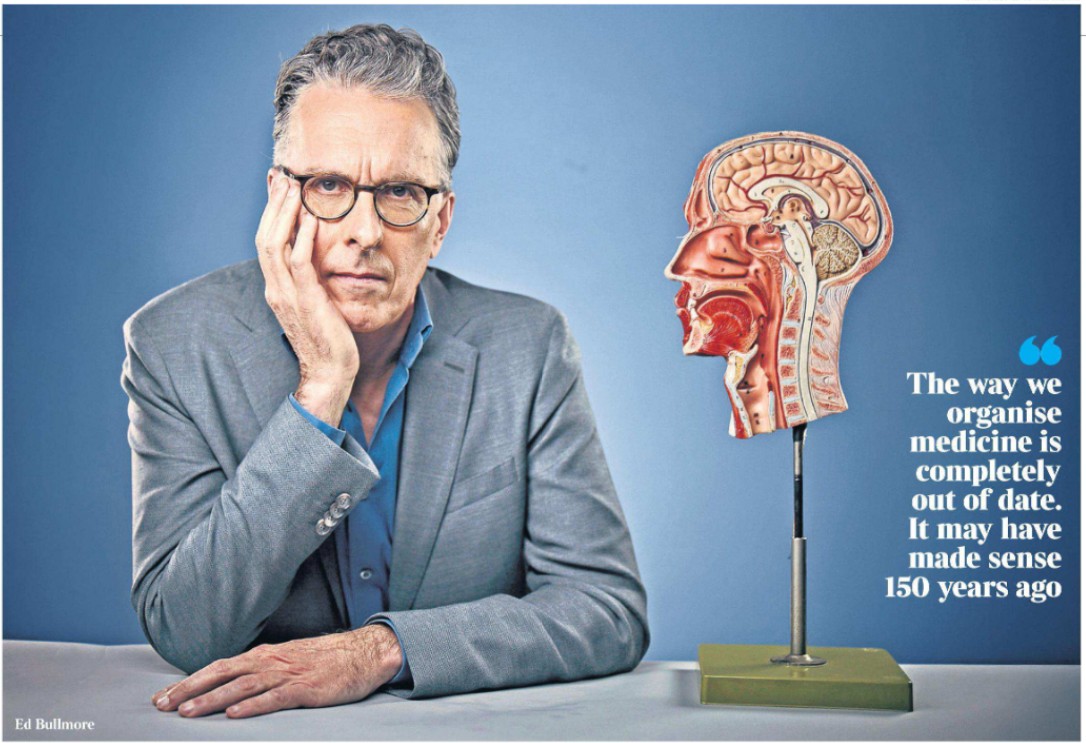
“The way we organise medicine is completely out of date,” he says. “It may have made sense 150 years ago, but the research of the last 20 years tells us otherwise.”
Bullmore came to public acclaim in 2018 for his bestselling book The Inflamed Mind, which was about the link between inflammation and depression. He says he received hundreds of messages from readers whose mental and physical health problems seemed woven together.
They asked Bullmore where they could find neurologists, psychiatrists and inflammatory specialists who worked as a team “to see both sides of the equation in an integrated experience ... I couldn’t find anyone.”
Depression is an interest of Bullmore’s, but his life’s work has been schizophrenia. He knows all too well that it is “one of the most demonised words in the English dictionary ... saturated in fear”, as he writes in his new book, The Divided Mind. No celebrity fronts this campaign. We are too scared to talk much of it, although its incidence is at nearly 1 per cent, which means it is coming for two teenagers out of my child’s 200-strong school year and soon.
We all think we know a little of what causes its dark devastation before we shove it out of our minds: some mysterious muddle of teenagers, genetics, cannabis and alienation, which is about where science got to by the end of the 20th century.
Emil Kraepelin, or as Bullmore calls him, “the most important psychiatrist you’ve never heard of”, was working in Germany in the 19th century and was the first to identify schizophrenia as we now know it. Kraepelin practised at about the time of breakthroughs in the germ theory of TB and believed this illness was caused by an unknown infection that damaged the brain.
Kraepelin was firmly denounced, first by Sigmund Freud, then later, in the 1960s, in RD Laing’s classic work The Divided Self. Both men saw schizophrenia as some kind of trauma response. So began, as Bullmore puts it, the civil war between those in the “brainless” (psychological) and “mindless” (biological) camps.
It has taken advances in MRI scanning and gene-mapping to return nearer to Kraepelin’s position. It has long been known that schizophrenia runs in families: if a first degree relative has it, your chances go up by 10 per cent.
But that doesn’t make sense of repeated and puzzling studies showing a link between a mother having a severe infection in pregnancy — enough to be taken to hospital — and her baby’s risk of getting schizophrenia as a young adult. In pregnancy illnesses such as flu, toxoplasmosis and rubella, among others, raised risk. For example, one large study in the Journal of Psychiatric Research in 2021 showed that a serious infection in pregnancy raised the risk that baby would develop psychosis in adulthood by 25 per cent.
The same goes too for a childhood infection serious enough for a hospital stay, especially if it is in the first years, and especially from viruses that can affect the central nervous system, such as measles, mumps, meningitis, Covid and flu. One study in the journal Schizophrenia Research in 2012 showed that a serious infection doubled the risk of psychosis in adulthood. Another British study published in Jama Psychiatry last year found that nine-year-old children who had raised inflammation markers were found to be five times more likely to develop psychosis or schizophrenia as young adults.
“Historically, it has been very difficult to explain that,” Bullmore says. “But if you bring the immune system into the story, some things can become clearer.”
Bullmore redirects us back to genes.
More than 100 genes are now implicated in schizophrenia. Not only are about a fifth of them connected to the immune system, they are also the ones most strongly associated with schizophrenia.
“The biggest hit is slap bang in the middle of the bit of the genome that is really important for the immune system,” Bullmore says. It is not the first time physical and mental health genes strongly overlap, he adds.
“Likewise, depression, if you look at its genetic risk, it’s quite highly correlated with the genetic risk for obesity. So there’s something in the genetic inheritance that puts people at risk of both physical and mental illness.”
You have probably heard of the process of “pruning” the synapses that occurs in the brain as we grow up.
This is when the body reshapes the young brain, trimming away parts that are no longer needed, to reorganise itself for the demands of adulthood.
The last dramatic pruning is as a young adult. This maps onto the window in which schizophrenia is likely to emerge.
What was news to me was that the “pruning” process is carried out in the brain by immune cells. These cells gobble up unnecessary brain synapses in the same way that they gobble up germs. Bullmore says that the new working hypothesis is that a disordered immune system may cause it to prune the brain in a strange way.
Muddled connections between brain parts for speech and thought may induce a schizophrenic to hear voices and find communication difficult.
“These advances in genetics shine a different light on how we think about schizophrenia, and on how we think about the relationship between the brain, the mind, and the body,” he says.
How much of a factor is early infections for developing schizophrenia? “I would say it’s very important for schizophrenia,” he says.
This, he cautions, is not something that should panic parents. Every child is riddled with standard illnesses, “it’s a normal and necessary development of the immune system ... but it’s looking at the earliest and most severe infections.
“One day it will be possible to do a blood test which will tell you not only if you are genetically at risk for schizophrenia, but if you have been exposed to the environmental features that activate that genetic risk,” he says. “We are not there yet, but it looks to be scientifically conceivable over, let’s say, five to ten years, bearing in mind I tend to underestimate how long it takes to do anything.”
At the moment, though, this news shouldn’t be used at an individual level as “just another thing to make parents feel guilty — that isn’t helpful”.
Instead, he says, “We need to think coherently about health from conception through childhood. It would be a wonderful thing if we could prevent severe mental illness instead of trying to treat it.
“For the sake of improving the physical and mental health of the next generation for the rest of their lives, we should be piling resources into mother and child health. I don’t understand why we’re not.”
Yet infant mortality rates have plateaued, and markers of child health such as vaccine rates, dental health and obesity are worsening. This year the UK had the lowest rates of MMR vaccination in the G7.
“If we allow child health to deteriorate, which is what we seem to be doing at the moment, the logical implication is that we are going to see increased risks of schizophrenia when the current generation moves into the age range of psychosis,” he says. “But it’s not just schizophrenia. People might say they don’t care about it and we don’t talk about it anyway, but it’s mental and physical health issues both that are so often linked to that early life experience.
“It makes me so angry that we’re not doing more. I say that as a boomer. I feel that we’ve been part of one of the luckiest generations ever. And I’m appalled to discover towards the end of my life that we don’t seem to be investing in the generations that will follow us in the same way that our predecessors invested in our futures when we were young. It is the best investment we can make.”
And as for the reunion of physical and mental health? “I’m a bit less optimistic that I will see a thoroughgoing revolution of the medical profession in my lifetime,” he says. But he has moved to King’s specifically because he can innovate there: he is beginning a pilot in which neurologists and psychiatrists are trained to “stay close” and is, he says, “pushing hard” on it in the next few years. Traditionalists, mind out.
The way we organise medicine is completely out of date. It may have made sense 150 years ago
The Divided Mind by Professor Edward Bullmore (New River £20) is published on Thursday. To order a copy go to timesbookshop.co.uk.
Free UK standard P&P on orders over £25. Special discount available for Times+ members.

No comments:
Post a Comment